Sunday, February 12, 2012

We have reached the village.....

Downtown shopping mall
with a surprising array of goods!

Goodhope Hardware Store
Internet cafe (when working),
copying and business supplies


Our downtown, or should we say
"downvillage" general dealer
Hanging out under the village shade tree
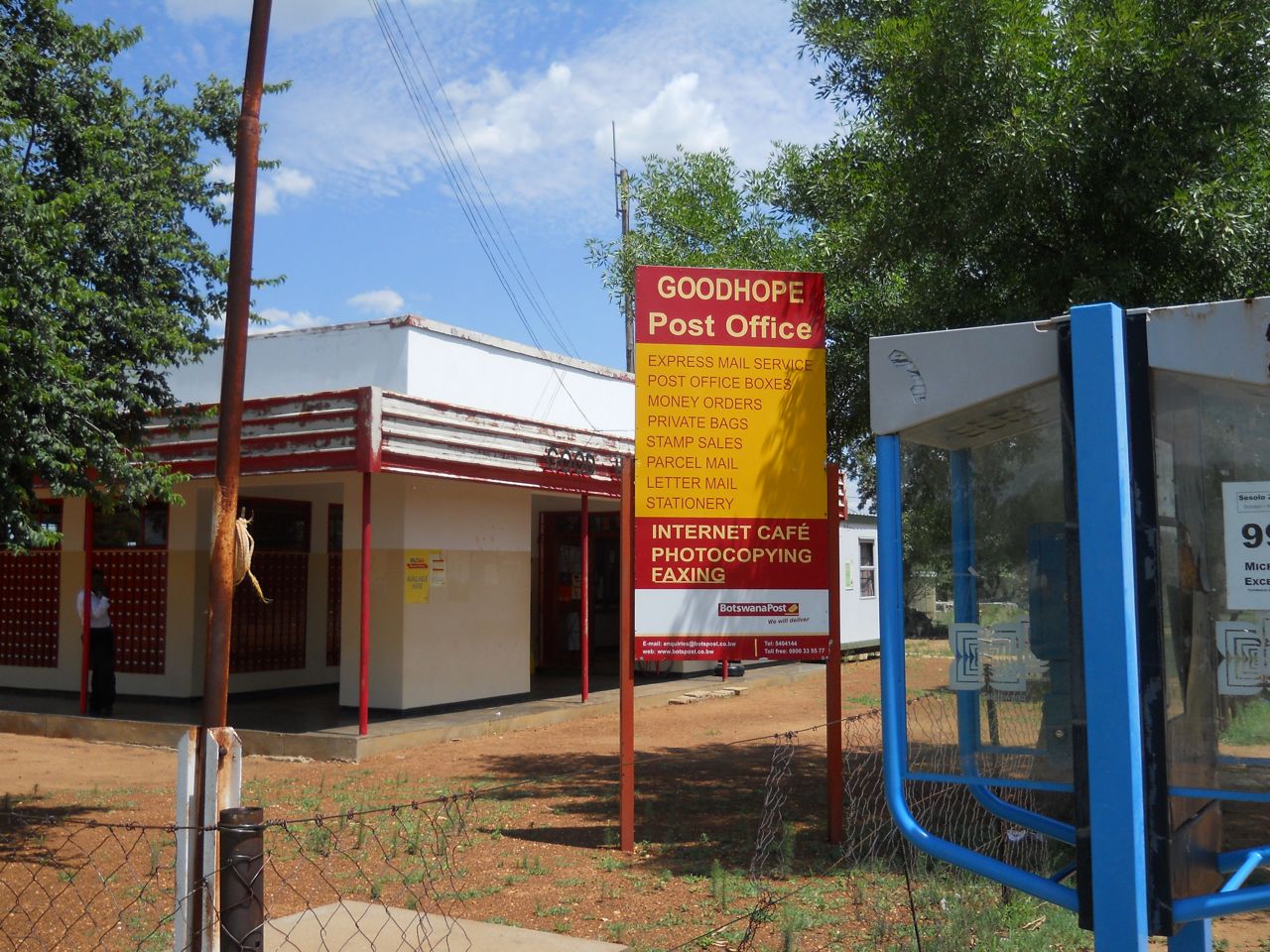
Our small but mighty post office

A site to visit but likely not use!
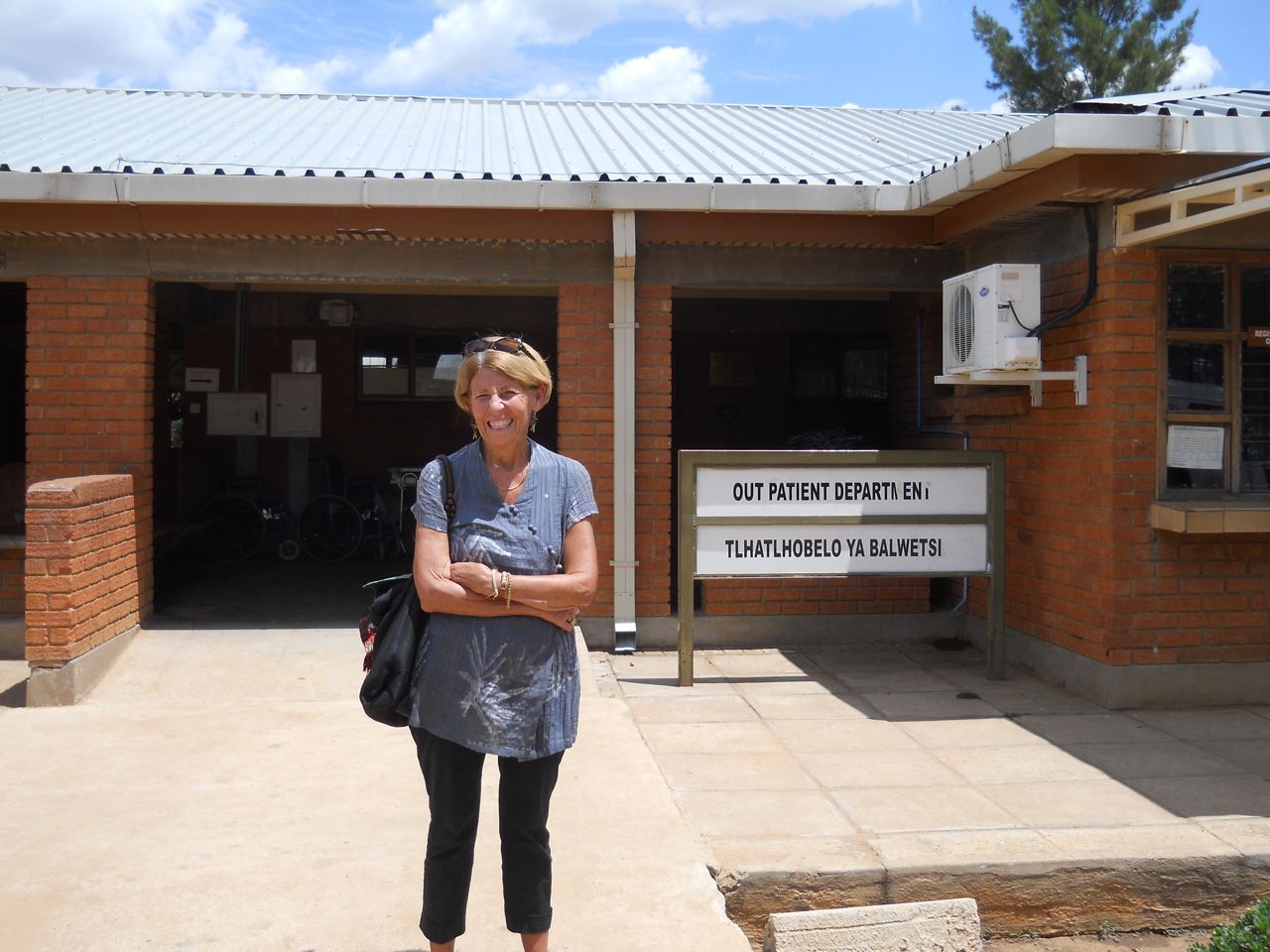
Carol hopes to collaborate here
at the Goodhope Primary Hospital
to initiate recovery services


Young friends always sharp in school uniforms!

Here we are at one of our favorite businesses,
        Saaz General Dealer
The long walk 'home'
Peace Corps is serious about community integration, so here you have it.... places where we visit to sustain our lives here in this small, yet very alive Village of Goodhope.

Saturday, February 11, 2012

 Life in the village......


It has been almost a month since we’ve written and time to give some air space to the Village of Goodhope. We really are part of two communities here: school and town.  The relations between the two are not very strong --- reminiscent of the ‘town/gown’ phenomenon in the U.S.  Sadly, the main contacts are when police or ambulance are called.  We hope that some of our work here will be as bridge builders between the two.  So far that idea is slow to gather momentum.

These pictures will give you some idea of the village. We have not highlighted the important places, rather, we show you all the places that we visit to get a combi, shop, copy a document or mail a letter (and views along the way). You will soon see that it is nothing like an African village on television or in the movies. Goodhope is quite typical of villages in southeastern Botswana --- quite spread out, a mix of old and new, and very sparse.

We begin our 3 km walk to the village on road from the school.......

On the road to the village.
The Goodhope Primary Clinic
is in the background.
Dwellings come in all shapes and sizes, from the modest.....
....to the home of the owner of the Crown Bakery that supplies
bread and baked goods to schools and general dealers!

Kagiso (translation: Peace) Bar,
which is very near Goodhope Senior Secondary
and a favorite place to hang out for teachers (and sometimes
students as well....)

Carol at the major intersection between school and village.

A local kraal, used to keep
cattle on hold for transport
Chickens in a coupe!

Goodhope Catholic Church, or the "Roman"
as it is called here. Wonderful music and
homilies in Setswana (we try to catch a word
or two that we know.....)

                                                  
Goodhope bus rank on a slow day....
...and on a busy day!
 
Our local Seven/Eleven!
We have almost reached the village center
and will continue soon....
Sending good wishes and love to you all!

Saturday, January 14, 2012


Nearly four months in Africa, two of them in Goodhope. And the beginning of a new calendar year.  A good time for reflections.  The African sky seems a metaphor for reflections.  Clear or dark, sunny or stormy, always vast and always different.  And what we are discovering here is that what appears to be an impending storm often is taking place elsewhere, passing us by.  Just as a photograph of clouds can give only a hint of the reality, these reflections scarcely convey the breadth and depth of the changes we have experienced here.


John:  People often ask me how the Peace Corps today is different from the Peace Corps I served in Panama from 1967-1969.  It is hard to answer.  My first response is that there is no comparison.  That is a bit evasive.  The whole world has changed in 43 years.  Technology has changed our daily life, communications and travel.  Carol and I don’t live in a traditional house, like I did in El Valle.  No one does in Goodhope.  I worked in “community development” in Panama, which meant figure out what could be done and do it.  Returning to El Valle to visit four years ago, I saw lasting changes.  Here in Goodhope our work is very focused.  That makes it easier and harder at the same time.  No way to know what changes may come of our time here.
Carol:  John has said it well, this experience is “easier” and “harder” than I could ever have imagined in the more than 40 years since Peace Corps service was but a dream for me.  Our Pre-Service Training in Kanye eased the transition into this very different culture for me. Our local teachers, our spirited and supportive training group of 35, the incredible coordination of classes and events (even for an “organized” soul as myself) was very impressive. The “harder” part for me has been, and continues to be not the lack of usual amenities (hot water,  any water....) but the depth of missing beloved family, friends, work and life in Portland. My aunt used to say “never leave fun for fun.” Then again, I left (for now) an amazing life as I knew it for an amazing adventure!   
John:  Peace Corps then and now is all about the people-to-people experience.  The opportunity over two years to become neighbors, colleagues and even friends across cultures, to learn new ways, share our ways, all of this is what makes Peace Corps’ experience so unique.  There are days when I feel isolated and utterly ineffective. The next day, I can feel connected, successful, and utterly excited about my work and the experience here.

Carol:  Yes, a roller coaster ride this certainly is.  Our huge welcome here by the 2500 students and faculty was followed by seven weeks’ term break and a nearly empty campus.  Elation and disappointment are common experiences, just as a beautiful sunset can suggest a pending storm.  Most hopeful for me right now is the invitation and interest at the Goodhope Primary Hospital to collaborate in beginning recovery services for patients struggling with substance abuse issues.  All of which fits so well with Peace Corps life skills focus in the public health arena. This possible “match” of my passion with a community need holds promise.  As John said earlier, only the future will tell.....


John:    It is challenging to understand process and time here!  Just this morning we attended a mandatory PTA meeting set for 10 a.m.  Indeed, the head of departments made a big pitch for being on time.  At the appointed time maybe 25 people were there, mostly parents.  No one from administration came in until 10:30.   A few parents wandered in, so that by 10:40, when the meeting finally started, there were maybe fifty parents and a dozen teachers.  The meeting was in Setswana.  After about ten minutes everyone stood for prayer.  Closing prayer.  We were surprised, to say the least.  It was explained that there were too few people to continue the meeting  It would be rescheduled until form fours (our U.S. equivalent is 11th graders) arrive.  I asked how many parents were expected, since most of the students are from quite far away and board here at Goodhope. One of the teachers responded:  “1200”.  Wow, it is impossible for me to understand that there will be a meeting with that many parents in February or ever.  Stay tuned.  We have been told that time operates differently here, and so it does.
Carol:  Yes, accepting what is here rather than what I would like it to be is quite the challenge. In training, one of our more seasoned PCVs said she prayed The Serenity Prayer many times a day for acceptance, courage and wisdom as she navigates this new culture. I am finding that to be so true! What I/we are experiencing now is the difference between theory (training) and practice (service).  When I asked John what one word he would use to describe this morning’s PTA experience, he said “humorous.” My word was “disappointing.”  Both are true, and fortunately, we both aren’t usually disappointed at the same time.


John:  People ask us if we are eating well and how we like the food here.  We eat well, and we cook for ourselves, alternating days so we share in the process.  Diets here are less varied and less seasoned than we are used to, but we can get a pretty good variety, between the general dealer (a small old fashioned country store) and a supermarket in one of the larger villages.  Sorghum porridge, a staple here, is ok, and we cook it occasionally, but we can get rice, potatoes, and pasta.  We might try growing potatoes!.  Beef is the other staple, and it is good, and very tough.  Seswa is pounded beef or goat, is easy to chew.  Serobe (goat tripe) is definitely an acquired taste.  Morogo (greens) usually refers to chard, which is very easy to grow in this climate, and  can be prepared in a lot of ways.  With peanut butter or lemon or potatoes and onions, in pattis (pancakes).  Especially the way Carol cooks it, maybe in our retirement we’ll open up the first Morogo restaurant in Portland.

Carol:  Now there’s a compliment! It is true we are becoming quite accustomed to the food here and finding inventive ways to put things together. Especially with whatever is in the fridge, since the nearest general dealer is a 40 minute walk and add a 30 minute kombi ride to that for the closest supermarket.  We are also eating foods here we would not dream of in our daily meals in the U.S.  Such as potato chips and sodas! Maybe with all the walking and gardening (and sweating!) we do, our bodies are asking for more sugar and salt. Who knows, but neither of us plan to return home “traditionally built!”  


These have been some glimpses of life here, and as the clouds you see, our experiences and how we are with all of it varies day to day and sometimes from moment to moment. We wish you all a joyous and fulfilling 2012, and love hearing from you. 
   We send you all  love across the miles!


Wednesday, December 28, 2011

It is the holiday season and we have been in Goodhope a month and a half, which seems like a very long time! Our lives have settled into somewhat of a pattern. Still, there are variations from day to day and definitely when the school is in session or as now, on term break.  We have recently returned from a visit to Gaborone for our Friday meetings and to see PCV friends for Christmas. Our school campus, as all others in Botswana, is like a ghost town; students, faculty and staff travel to their home villages for Christmas and New Year’s celebrations. 
Now is also the time when Batswana plough the wet ground and plant summer crops.  We have learned that summer has a different definition here! In Portland, we look forward to summers of  sunny skies and less rain.  Here, summer means rain, and even though summer solstice was just a few days ago, we have had some of our coolest days.  Today, as we write, the skies have opened up.  A real “gullywasher” - with thunder, lightning and a stiff breeze.  Most days the sun shines, but when it starts getting really hot, clouds appear --- huge and dramatic --- covering the sun and mitigating the heat.  
Today is the first real rainstorm in a year when the rains have been late.  Pula is the word for rain.  It means good luck.  And it is the name for the currency. Pula! It is precious here, very precious. Without it, the dry red soil produces little except thorn bush and cactus. The rains produce an almost magical green all about. In our garden we know are seeing squash, beans, morogo (greens) and marigolds sprout up. And many many weeds.  
I'm a little incredulous after
three months of incessant
sunshine!

Rain, and lots of it.  The first big
storm is already causing the JoJo, our
auxiliary water supply from the gutter,
to overflow.


So, with the rain, the absence of everyone but us from our school community, and in the spirit of Mma Ramotswe, we think this is a good time for a cup of bush tea with milk and honey.  An excellent accompaniment to the cookies we are baking from the Peace Corps Botswana cookbook.  What is our daily life here in this very new environment?   Now on holiday, the pace has been very slow, and by that we mean: slow!  We are learning the Batswana way.  We awaken without an alarm, enjoy a breakfast of cereal or eggs, sometimes yogurt and fruit. And always yummy coffee made in our french press.  We are quite fortunate to have such a well-equipped kitchen: four-burner gas stove, a refrigerator, and, most of the time, running water.  The water problem is the bane of Goodhope. when the school is filled with 2400 teachers and 160 teachers, the almost daily water outages are not much fun.

Tea time during the storm!

Our commitment to Peace Corps service is one step at a time, each day.  Often this means arranging a meeting with a village leader or business, government or medical worker.  Goodhope is a 3 km walk from campus -  as strange as it seems to Batswana professionals, we do not have a car and do not drive.  Few people walk, but we walk a lot. And always people notice us, as the “makgoga” (Setswana word for white folks, literally “washed up from the sea”)!  


My kitchen in Panama in first PC service had nothing like this.  Come to think of it
I didn't have a kitchen in Panama.  Just four walls and a roof.  Still,
this isn't the Posh Corps.  


This is Phase One of Peace Corps service: community integration.  We have met with the staff at the primary clinic, the hospital, district government offices, agriculture and forestry ministries and the police.  We had a wonderful meeting with Kgosi Lotlameng II who is the traditional leader for Goodhope and all villages 
between here and the South African border (He explained that the border split the Barolong lands in half.  His cousin is the kgosi in Mafikeng, on the other side of the border).  John is engaged in contacting various community persons for participation in the school Job Shadowing program, which we hope to develop this year. Carol was invited to present an in-service talk with medical staff at the Goodhope Primary Hospital on substance abuse (major problem in Botswana and linked to the spread of the HIV/AIDS virus) and treatment options, and has found interest there in beginning a recovery meeting. So there is hope in Goodhope!

 At our dining room table, sewing
table, game table, all-purpose and only
table,  beginning my quilt project.

The two weeks that school was in session before winter break gave us an idea of what is to come.  We spent those days getting up early to be at morning assembly at 7:10 a.m. We met with teachers and students, individually and in groups.  With the help of several students, we cleaned out a big room that will serve as the Life Skills and Career Counseling Center and may also be the headquarters of the Goodhope Bridge Club.  
Now on term break, we are home for lunch, and spend afternoons working on life skills plans, Peace Corps reports, emailing family and friends, washing clothes in a tub, hanging them to dry, cooking, playing guitar (John), sewing curtains and now a quilt (Carol), reading and gardening (both of us).  We both read John Hersey’s A Single Pebble - must reading, we both agree, for Peace Corps volunteers.  We each borrowed the same book, purely by coincidence,  from the Peace Corps library,  Nadine Gordimer’s  A Sport of Nature.  A riveting story of Africa and liberation. Hardly a day goes by without playing “Bananagrams”. Quite a competition between us, often making up our own rules, such as “must use a family member’s name” or  “one word required in  Setswana.”  And the most challenging one yet: “only words that begin with vowels.” We are getting sharp to take on local Portland friends who are geniuses at this game (you know who you are!). Just wait until our return... 


Our gratitude to have one another as good company is immense! We often think of single volunteers. which was John’s experience during his first service, and feel thankful for the companionship and fun we enjoy while at the same time feeling so lonely for beloved family and friends.  And gratitude for all of you, our loved ones so far away.  We send holiday blessings, love and every wish for 2012 to be an amazing new year.


Friday, December 16, 2011


We would love to share something of nature with you. Although we have not travelled widely in Africa, we have enjoyed landscapes and wildlife (by that we mean, cattle, goats and sheep in this part of Botswana!).  Here in Goodhope, where it is flat and trees are sparse, the sky is an enormous dome over a thin line of horizon ---always dramatic--- whether it is simply the purest of blues, a thunderstorm is brewing, or the sun is setting in the most amazing displays we have ever seen.  How can we capture that in a camera?  A great photographer could barely do it justice.  Here is our best effort....

From the top of the hill in back of our house in Kanye we 
could see an enormous panorama.
The dome of the Kanye mosque is in the center.
Taken from the same spot.  The statute is of the kgosi, 
grandfather of Kgosi Malope II
 whose coronation we attended in October.
 Are these jacaranda trees?
 They were magnificent, especially when they were growing
in long rows, all over Kanye. 
 Springtime in Kanye meant flowering trees everywhere.
This is a conifer. Strange looking flowers or fruit, not cones.
These trees were blooming when we first arrived. 
 They remind us of the Cay Mai, which has near sacred status in Viet Nam.
  Jody thinks it may be the same.


The wild, or not so wild, donkeys of Kanye.  This one is wandering
just outside the main shopping mall.
The tallest tree in Kanye is an Araucaria, from Chile.
Who brought it here is a good question!
This is Thamaga Hill.  It’s higher than it looks in this picture, an enormous pile of smooth, 
rounded rocks that look like they could roll down any minute, 
although theyprobably have been there for millennia.
More of these gigantic stones in and around Thamaga.
Our favorite ancient tree, along the road from school to Goodhope village.
Weaver birds have built nests in the thorn tree outside our kitchen door.  
They are gorgeous bright yellow, industrious home-building birds 
considered pests by local farmers.
We watched this bird building a new nest which he finished in a day!
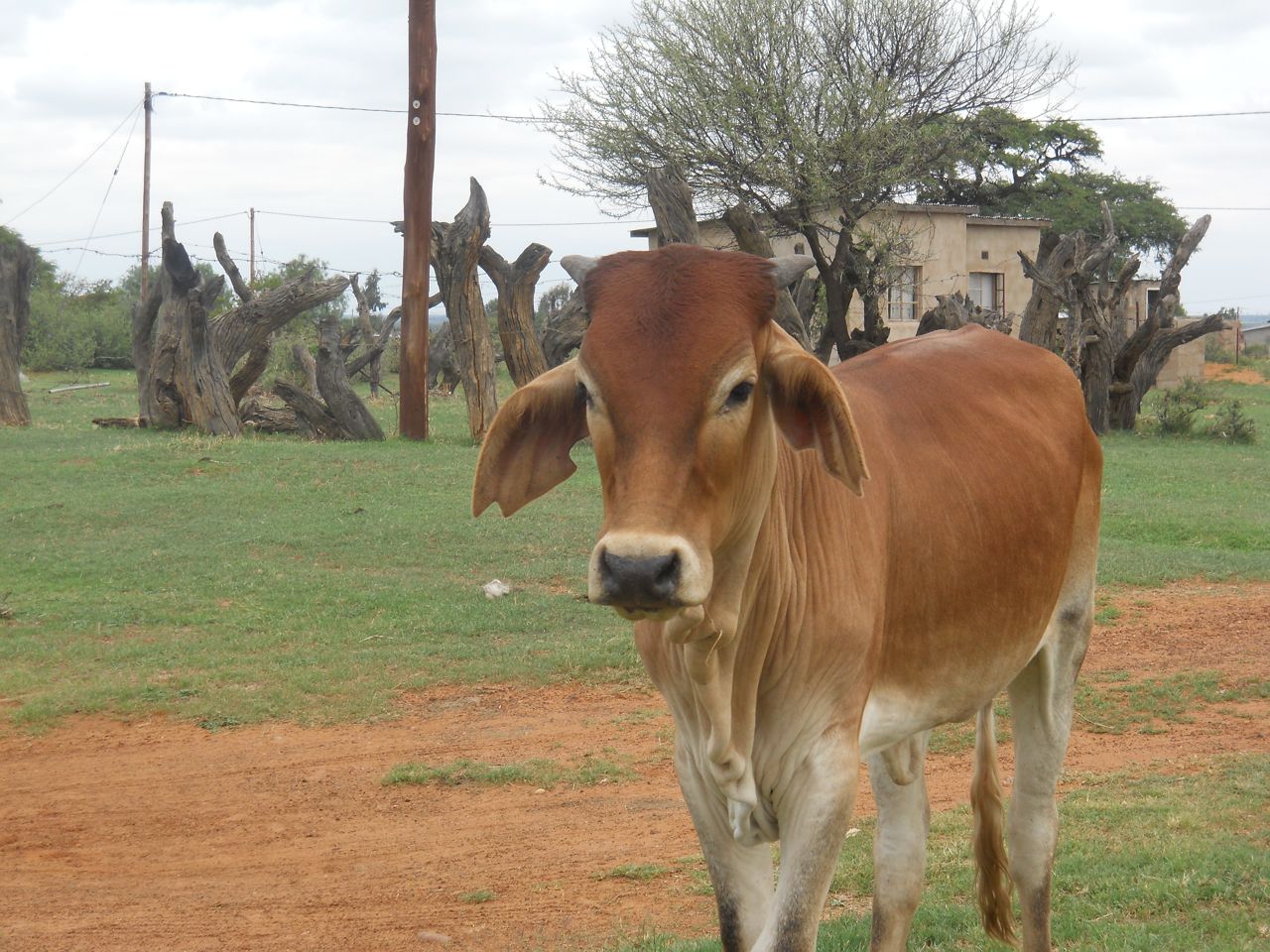
This is the most prevalent form of four-legged fauna in this part of Botswana.  
We are told that there are several times more cattle than people in this country.  
Cattle wander freely, literally everywhere!
There are some beautiful and interesting birds in addition
to the weaver birds.  Most are small and swift, hard to capture 
with a camera.  There are always plenty of chickens
 willing to pose.
Mostly the cattle seem to roam on their own, but, especially in large groups, 
there may be a herder.  Cattle, as well as goats and donkeys, are a road hazard.
On the road again.  We just can't wait to get back on the road again:  The road from our school to Goodhope Village. 
Sometimes we can try to improve on nature.  If our garden will grow in this sandy soil.
Squash and melons are doing ok.  And beans and lentils...
Another way to solve the trash problem.  Nor much of a
nature picture.  Maybe the ashes will improve our soil.  The
Sunflowers we planted along the brick wall of the garbage
station are doing pretty well!! 
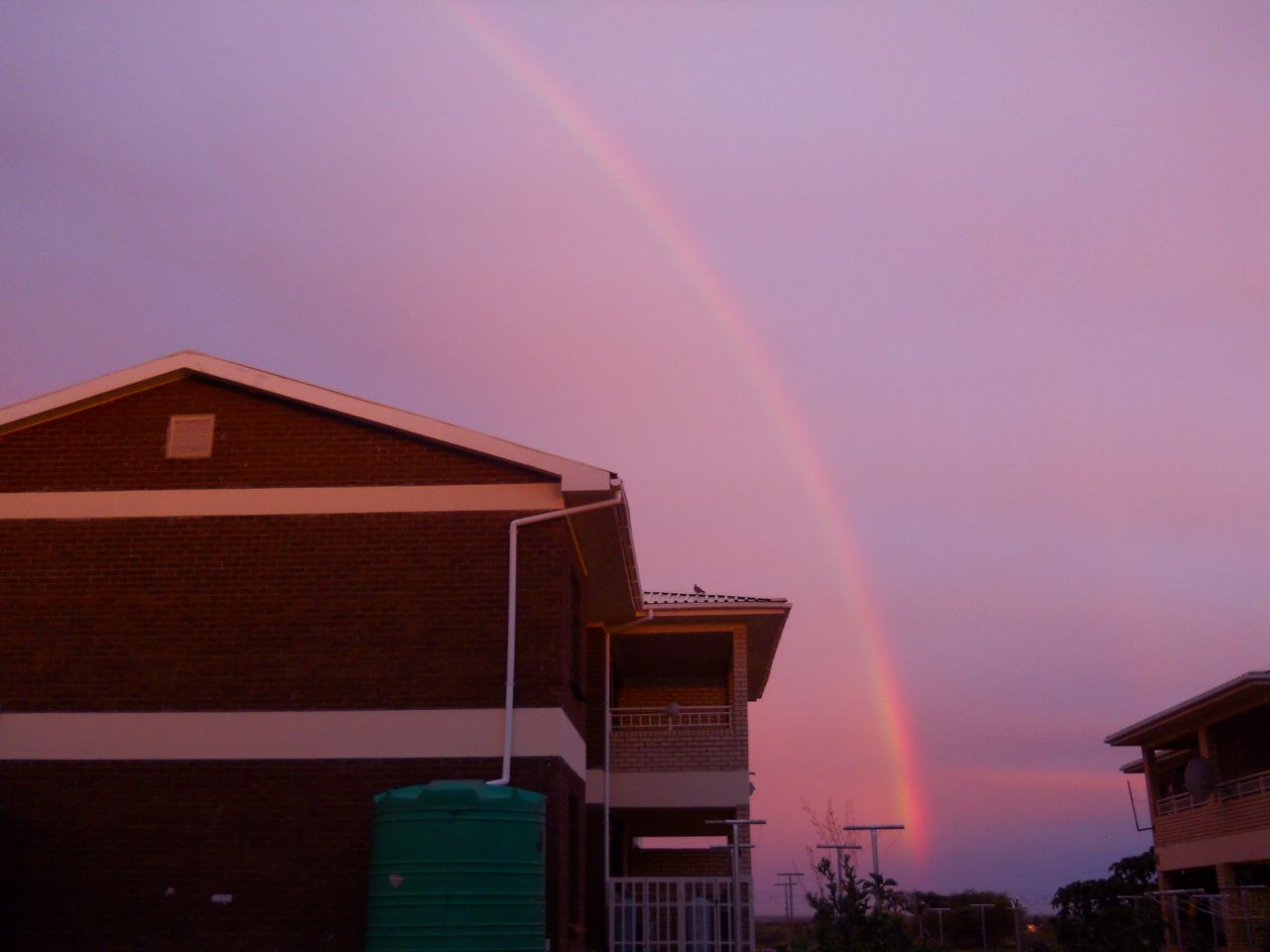
We looked out our window and saw a red streak that grew,
as the sun went down, into one of the most beautiful and
complete rainbows we’ve ever seen.
Rainbow connection, the other side of the rainbow.

The Good, the Bad, and the Ugly.  Sunset with water tower and dump station.

 An African sunset is like no other.  This is the end for now.  Blessings and Joy to all this Christmas.